
Uncategorized
How Long Will Urine Stay Good for Testing

Sep
An unpreserved urine sample is generally reliable for routine testing within about 1–2 hours at room temperature. Refrigeration at 2–8°C can extend that window to roughly 24–48 hours, depending on the test.
You may be asking because you collected a sample at home and can't reach the laboratory immediately, or because an at-home drug test kit arrived later than expected. The container may still look normal, but appearance alone can't show whether the chemistry has shifted. The useful question isn't just how long urine stays “good.” It's good for which test, at what temperature, and in what container?
Table of Contents
- The Short Answer Most Readers Are Looking For
- What Actually Changes in Urine After Collection
- Storage Conditions and How Each One Affects Timelines
- Why the Window Depends on the Type of Test
- A Real-World Example of How Mishandling Skews Results
- Preservatives and Dried Urine as Stability Options
- Putting It Together and What to Do With Your Sample
The Short Answer Most Readers Are Looking For
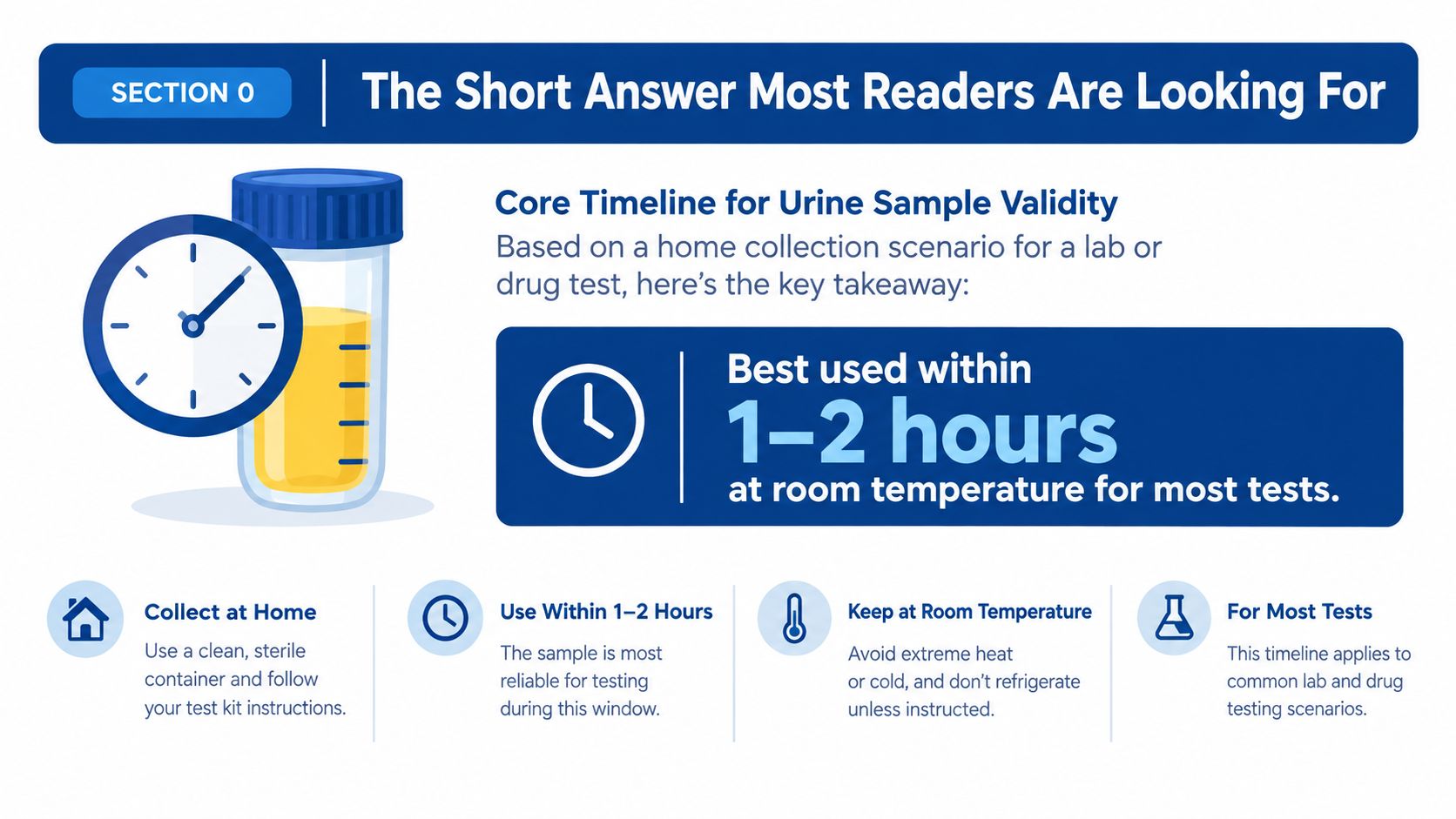
For most routine urinalysis, use an unpreserved sample within 1–2 hours if it remains at room temperature. Laboratory guidance recommends testing within about an hour when possible, and notes that delays beyond roughly two hours can make an unpreserved specimen unreliable for routine examination, especially when bacteria and cells are being assessed. See the laboratory guidance on specimen collection and handling for the practical basis of this window.
If you can't deliver the sample promptly, cap it tightly and refrigerate it at 2–8°C. Depending on the assay, refrigerated urine may remain usable for approximately 24–48 hours. The CDC urine specimen guidance shows why no single deadline applies to every test. Some specimens need immediate refrigeration and cold shipping, while certain assays permit room-temperature storage for up to 8 hours, followed by refrigeration for up to 48 hours before freezing.
Practical rule: If the instructions supplied with the test give a shorter window, follow those instructions. The laboratory's method, preservative, container, and target analyte determine what “usable” means.
A sample kept overnight at room temperature is a different situation from one refrigerated soon after collection. A refrigerated sample may still be acceptable for some chemistry measurements, while its cells or other fragile components may no longer support dependable microscopy. The sections below separate those situations instead of forcing them into one misleading number.
What Actually Changes in Urine After Collection
Urine doesn't stop changing when it enters a sterile cup. At room temperature, bacteria can multiply quickly. Their activity can alter acidity, consume some substances, and produce by-products that weren't present at collection in the same amounts.
That matters because different parts of a urinalysis depend on different kinds of stability. A dipstick may measure glucose, protein, blood, or pH, while microscopy examines cells, casts, crystals, and organisms. These targets don't all deteriorate at the same pace.
Chemistry can drift before the sample looks different
Bacterial activity can reduce glucose and increase pH. Nitrite may rise as certain bacteria act on urinary compounds. Light and air can contribute to oxidation of bilirubin and urobilinogen, while evaporation can concentrate dissolved substances if the container isn't properly sealed.
Cells are also vulnerable. Red blood cells, white blood cells, and casts can break down during a delay, especially in urine with conditions that make them less stable. A report may therefore show fewer intact cells than were present when the sample was collected.
Crystals and sediment can be misleading
As pH and temperature change, dissolved materials can precipitate into crystals. Refrigeration itself may make some crystals more visible, so a laboratory may need to bring a chilled sample back toward room temperature and mix it according to its procedure before analysis.
| Parameter | Typical change | When it becomes noticeable |
|---|---|---|
| Bacteria | Multiplication and increased contamination risk | Quickly at room temperature |
| pH | May become more alkaline as urea breakdown progresses | During room-temperature delay |
| Glucose | May decrease as bacteria consume it | During prolonged holding |
| Red and white blood cells | Cellular breakdown and loss of intact forms | Within hours in vulnerable specimens |
| Casts | May disintegrate | During delayed examination |
| Bilirubin and urobilinogen | Oxidation can alter measured values | With exposure to light and air |
| Crystals | Precipitation may increase as conditions shift | After temperature or pH changes |
The urinalysis transport memo from the University of Rochester Medical Center describes the central limitation clearly: preserved urine can remain usable at ambient temperature for about 48–72 hours in some tube systems, but red and white blood cells still showed lower agreement with original results after prolonged storage. Stability is therefore analyte-specific, not a property the whole sample either has or loses at once.
Storage Conditions and How Each One Affects Timelines
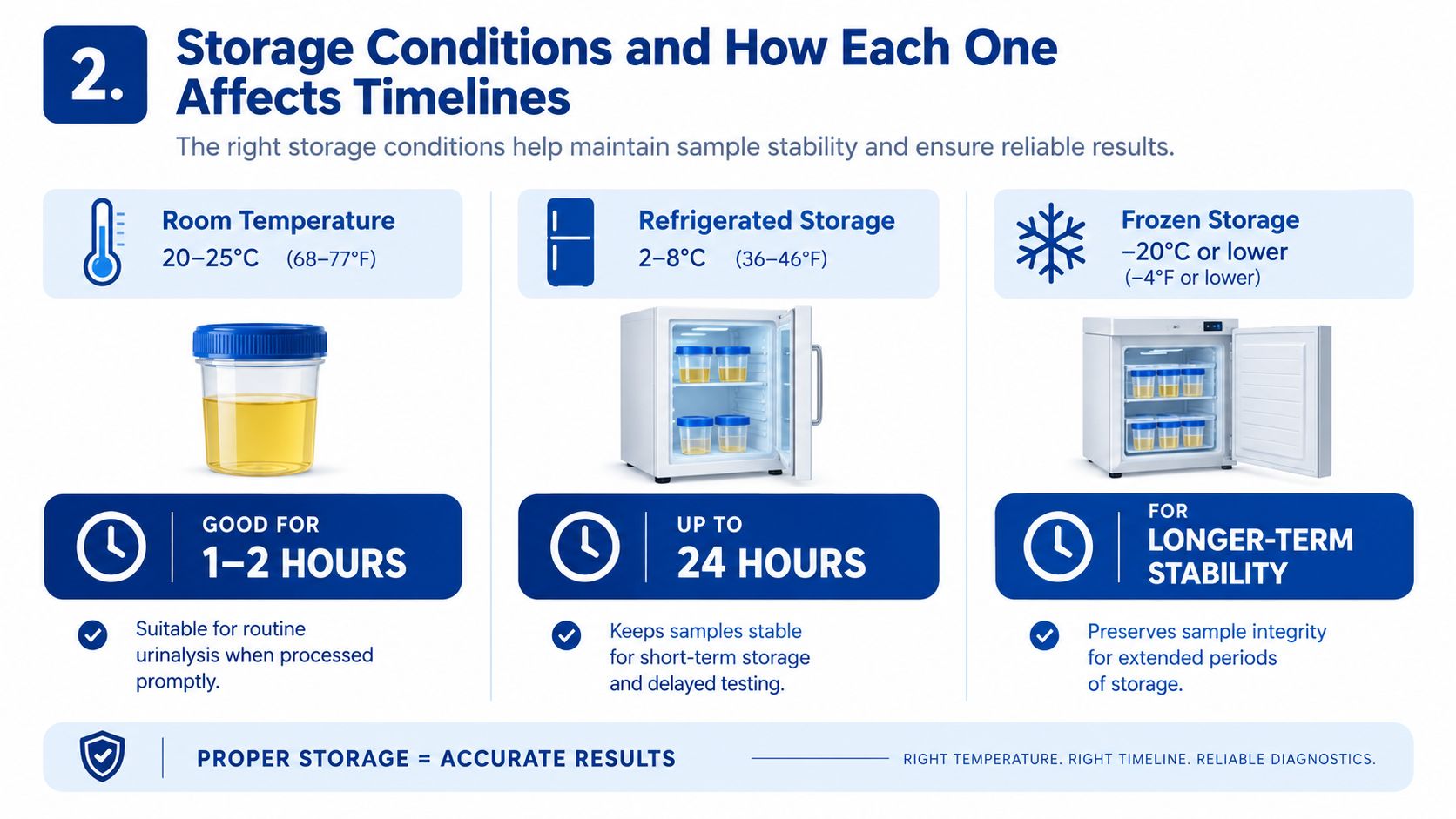
Temperature is the most practical control a reader can use. A clean container and tight cap reduce contamination and evaporation, but they can't fully stop biological activity. Refrigeration slows those processes, while freezing changes the physical structure of the specimen and should be used only when the test protocol permits it.
Room temperature
For an unpreserved sample intended for routine urinalysis, aim for processing within 1–2 hours. Guidance cited by the University of Rochester describes bacterial growth and cellular breakdown as rapid concerns, and longer room-temperature storage can compromise microscopy and chemistry.
Don't leave the cup in a warm bathroom, car, or sunlit area while assuming that a normal color means a stable sample. Warmth accelerates bacterial activity, and the sample can become unsuitable before the change is obvious.
Refrigeration
If immediate delivery isn't possible, refrigerate the sealed sample at 2–8°C as soon as possible. General laboratory guidance commonly supports holding urine for roughly 24 hours under these conditions, while some test systems allow up to 48 hours. The exact limit depends on the analyte, preservative, and laboratory procedure.
Label the container with the collection time, not merely the date. A laboratory needs that information to judge whether the specimen fits its acceptance criteria. Refrigerated urine may also develop precipitates, so don't interpret cloudiness by itself as proof that the sample has failed.
Freezing
Freezing can support longer-term stability for selected chemistry and research applications, but it isn't a universal extension of the refrigerated window. Ice formation can disrupt cells and alter the physical distribution of dissolved substances. A frozen sample may therefore be unsuitable for microscopy or for a method that requires intact cellular morphology.
Before freezing: Check the test instructions or ask the laboratory. Don't freeze, thaw, and refreeze a specimen unless the protocol specifically allows it.
Use a sterile, leak-proof container, cap it firmly, record the collection time, and avoid unnecessary temperature changes. The CDC laboratory test directory illustrates how storage allowances vary widely by assay, including methods that require cold packs during overnight shipment.
Why the Window Depends on the Type of Test
A routine urinalysis, a drug screen, and a timed chemistry collection don't ask the laboratory to preserve the same information. That difference explains why a sample can be acceptable for one measurement but weak evidence for another after the same delay.
Routine urinalysis often combines dipstick chemistry with microscopy. Glucose, pH, protein, red cells, white cells, and casts can respond differently to bacterial growth, oxidation, temperature, and time. An unpreserved specimen held at room temperature is therefore best handled within the short window already described.
Drug testing may focus on parent compounds and metabolites, but stability still depends on the substance and the sample's conditions. A review of urine drug stability found that most drugs remained stable for months when refrigerated or frozen, while room temperature generally supported only about one day before measurable alteration became more likely. The review of urine drug stability also discusses why refrigeration is a practical benchmark during transport and short-term holding.
A 24-hour collection is different again. The collection often uses a prescribed container and may require a preservative from the first void. Don't transfer part of that collection into an ordinary cup or choose a preservative yourself, because the wrong additive can interfere with the intended assay.
| Test type | Key analytes | Room-temperature limit | Refrigerated limit at 2–8°C | Why it degrades |
|---|---|---|---|---|
| Routine urinalysis | pH, glucose, protein, cells, casts, crystals | About 1–2 hours for unpreserved urine | Roughly 24–48 hours depending on the method | Bacteria, cellular breakdown, oxidation, and precipitation |
| Drug testing | Drugs and urinary metabolites | Test-specific, with stability decreasing during prolonged holding | Often extended, but the laboratory protocol controls acceptance | Degradation, bacterial activity, and changes to specimen validity markers |
| Timed urine chemistry | Hormones, catecholamines, creatinine, and other ordered analytes | Usually follows collection-specific instructions | May require refrigeration or a named preservative | Oxidation, bacterial activity, and incorrect collection conditions |
If you're researching urine drug testing procedures, use the collection site's instructions rather than assuming a general household storage rule applies. The right question is not “Can this urine still be tested?” but “Can this laboratory still measure the requested target accurately?”
A Real-World Example of How Mishandling Skews Results
Consider a person who collects urine at 7 a.m., leaves the sealed cup in a bathroom, and delivers it to a laboratory two days later. The sample may still have a familiar color and may not look dramatically different, but its measured properties could have shifted substantially during the delay.
At room temperature, bacteria can multiply and consume glucose. The pH may rise as urea breaks down, and formed elements such as casts can deteriorate. If the container isn't completely sealed, evaporation may also concentrate solutes, making some measurements appear higher because water has been lost.
For a drug screen, the outcome isn't predictable from appearance. Some compounds may remain comparatively stable, while other drugs or metabolites can change during prolonged warm storage. The laboratory might reject the specimen, request recollection, or receive a result that appears technically reportable but doesn't accurately represent the sample at collection.
What the report might show
The hypothetical report could include:
- Glucose lower than expected, because bacteria consumed some of it.
- A shifted pH, reflecting bacterial activity and chemical change.
- Fewer intact cells or casts, because fragile structures broke down.
- Altered drug or metabolite relationships, depending on the substance and degradation pathway.
- Specimen-validity concerns, if concentration, appearance, or other checks no longer fit the laboratory's requirements.
A product marketed for specimen substitution or drug-test circumvention isn't a solution to poor medical specimen handling. For legitimate testing, follow the collection site's chain-of-custody and transport requirements, and consult the laboratory if a delay has already occurred. Information about synthetic urine kits should not be treated as permission to replace, alter, or misrepresent a clinical or legally supervised specimen.
The safest response after a major delay is usually to disclose the collection time and ask whether recollection is needed. Don't guess based on whether the cup “looks fine.”
Preservatives and Dried Urine as Stability Options
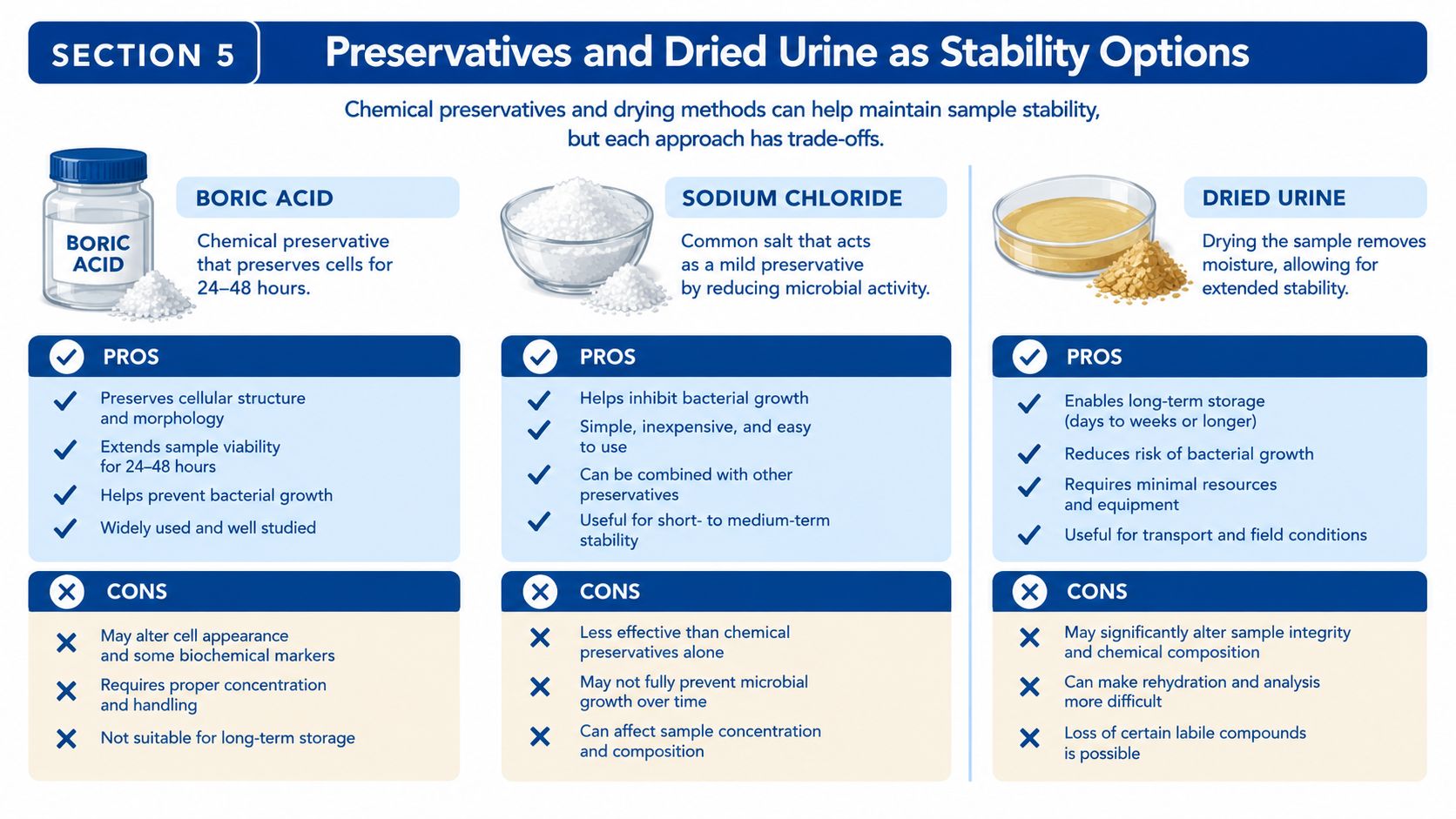
Some laboratories extend stability with a validated preservative or a collection format designed for transport. These options work only when they match the test. Adding a chemical to an ordinary sample can protect one analyte and invalidate another.
Boric-acid systems are used in some urine transport tubes to limit bacterial growth and help preserve specimens during delayed processing. Sodium fluoride can help stabilize glucose by inhibiting glycolysis. Acid preservatives, including hydrochloric acid, may be specified for catecholamine or hormone collections where oxidation is a concern. Other assays may use different additives, such as thymol or toluene, under tightly defined instructions.
The container label matters as much as the liquid inside it. If a kit supplies a preservative tube, fill it to the indicated level, mix it exactly as directed, and don't transfer the sample into another container unless the instructions say to do so.
Dried urine changes the logistics
Dried urine cards or filter-paper formats remove most of the water that bacteria and enzymes need for activity. A 2025 Royal Society of Chemistry study reported that dried urine samples were non-biohazardous and remained stable for up to 5 days at 40°C and 4 months at room temperature. Those findings apply to the studied dried format and analytes, not automatically to ordinary liquid urine.
This creates an important contrast. Standard liquid urine guidance generally calls for refrigeration at 2–8°C when analysis will be delayed beyond roughly two hours, while a validated dried format may tolerate room-temperature shipping for much longer. The study on dried urine stability supports the format's potential, but it doesn't mean a reader should dry a liquid sample at home.
| Option | Main benefit | Main limitation |
|---|---|---|
| Validated chemical preservative | Slows a specific type of deterioration | The wrong preservative can interfere with the assay |
| Refrigerated liquid urine | Practical short-term protection | Does not preserve every analyte or cell equally |
| Dried urine card | Easier transport and reduced biological activity | Only suitable for validated test menus and collection procedures |
Putting It Together and What to Do With Your Sample
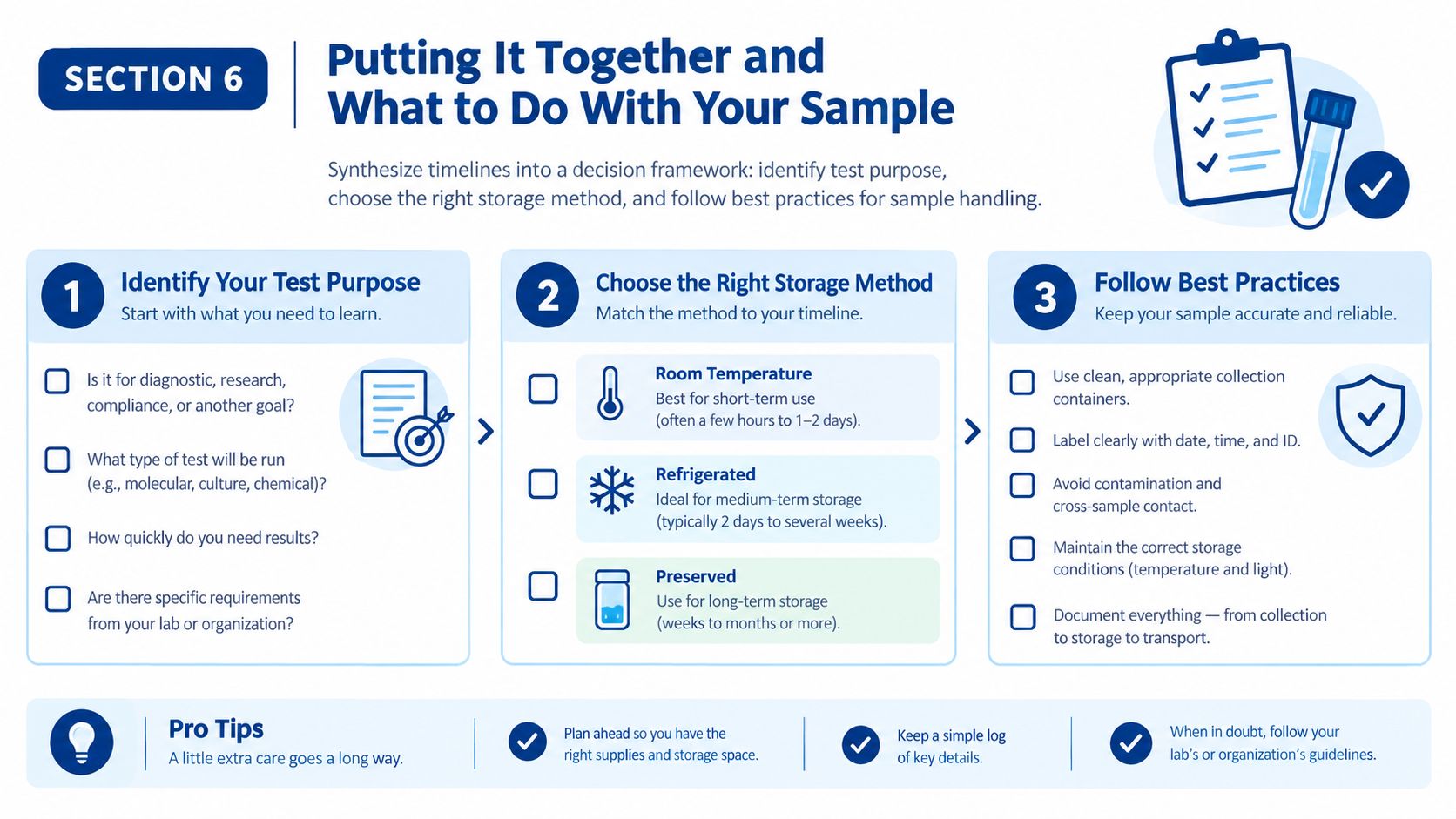
Start with the test, not the container. A sample for immediate dipstick screening has different handling needs from a timed hormone collection, a microscopy specimen, or a specialized drug assay. Read the kit's instructions before collecting because the required cup, preservative, fill volume, and shipping method may be part of the test itself.
A practical handling checklist
- Identify the purpose. Write down whether the sample is for routine urinalysis, drug testing, a timed collection, or another assay.
- Choose the shortest safe route. Deliver an unpreserved sample promptly at room temperature. If that isn't possible, refrigerate it at 2–8°C unless the instructions specify another condition.
- Use the supplied container. A sterile, leak-proof, tightly capped container reduces contamination and evaporation.
- Record collection time. The laboratory can't judge a delay accurately if it doesn't know when collection occurred.
- Follow shipping instructions. Some tests require cold packs, overnight transport, a preservative, or a dried format.
- Ask before improvising. Don't add household chemicals, freeze a sample, or transfer it between containers without laboratory approval.
When recollection is the better choice
A slight delay may be acceptable when the sample was sealed, refrigerated promptly, and collected for a method that permits that hold time. A prolonged warm delay, an unknown collection time, leakage, contamination, or an unapproved preservative creates a stronger reason to contact the laboratory and ask about recollection.
For readers comparing at-home urine drug-testing guidance, remember that a home screening result isn't automatically equivalent to a laboratory-confirmed result. Follow the kit's timing and storage directions, and treat an unexpected result as a reason to seek appropriate professional testing rather than as a diagnosis.
In practical terms, use unpreserved urine quickly, refrigerate it when the laboratory allows a delay, and never assume freezing or household preservation is interchangeable with a validated protocol. The sample may remain physically recognizable long after its most important measurements have become unreliable.
Supreme Klean offers information and products for people researching urine, hair, and saliva drug testing, including at-home screening kits and collection-related guidance. Visit Supreme Klean to review the available resources and choose the information relevant to your testing situation.
Built with the Outrank app
