
Uncategorized
Shampoo for Hair Drug Test Prep: What Actually Works
Sep
You've got the notice, maybe only a few days out, and now you're trying to figure out which shampoo for hair drug test prep matters and which products are just internet noise. That panic is normal, because hair testing is built to catch long-term history, not a single bad night, and a one-and-done wash rarely changes that reality. If you want a straight answer, start here: Macujo Aloe Rid® Shampoo and Zydot Ultra Clean are not interchangeable, and the routine only makes sense when you know what each one is trying to do.
| Feature | Macujo Aloe Rid® Shampoo | Zydot Ultra Clean |
|---|---|---|
| Role | Core wash inside Mike's Macujo Method | Final cleansing rinse on test day |
| Timing | Used repeatedly across several days | Used once near the end |
| What it targets | Part of the deeper prep sequence | Surface residue and styling buildup |
| Can it stand alone? | No, it's part of a full method | No, it's a finishing step |
| Best use case | Heavier exposure, repeated use, tighter prep | Same routine, final hour before collection |
Table of Contents
- Why You Are Looking for a Hair Test Shampoo Right Now
- How Labs Read a Hair Sample
- The Two Shampoos People Compare and What Each One Does
- Mike's Macujo Method Versus the Older Macujo Method
- What Forensic Research Says Shampoo Can and Cannot Remove
- How Mike's Macujo Method Uses Macujo Aloe Rid® Shampoo
- Body Hair, Last Minute Fixes, and Common Misreads
- Matching the Right Routine to Your Situation
Why You Are Looking for a Hair Test Shampoo Right Now
You usually start searching because the timing is ugly. A pre-employment screen lands on your calendar, or an employer gives you a short window, and suddenly you're staring at a test that doesn't behave like urine or saliva. Hair testing reaches back over a much longer period, so the fear isn't just “what did I do yesterday,” it's “what did the lab just lock into my hair?”
That's why people reach for a shampoo for hair drug test in the first place. They've already figured out that home urine tricks don't solve a hair test, and they want a way to lower risk before collection day. The problem is that the market sells too many products as if any bottle will do the same job.
It won't. One shampoo, used once, almost never solves a hair test. The practical answer is a sequenced routine, not a single cosmetic rinse, because the lab is measuring what's inside the sample, not just what sits on the outside.
Practical rule: if your plan is “wash once the night before and hope,” your plan is weak.
How Labs Read a Hair Sample
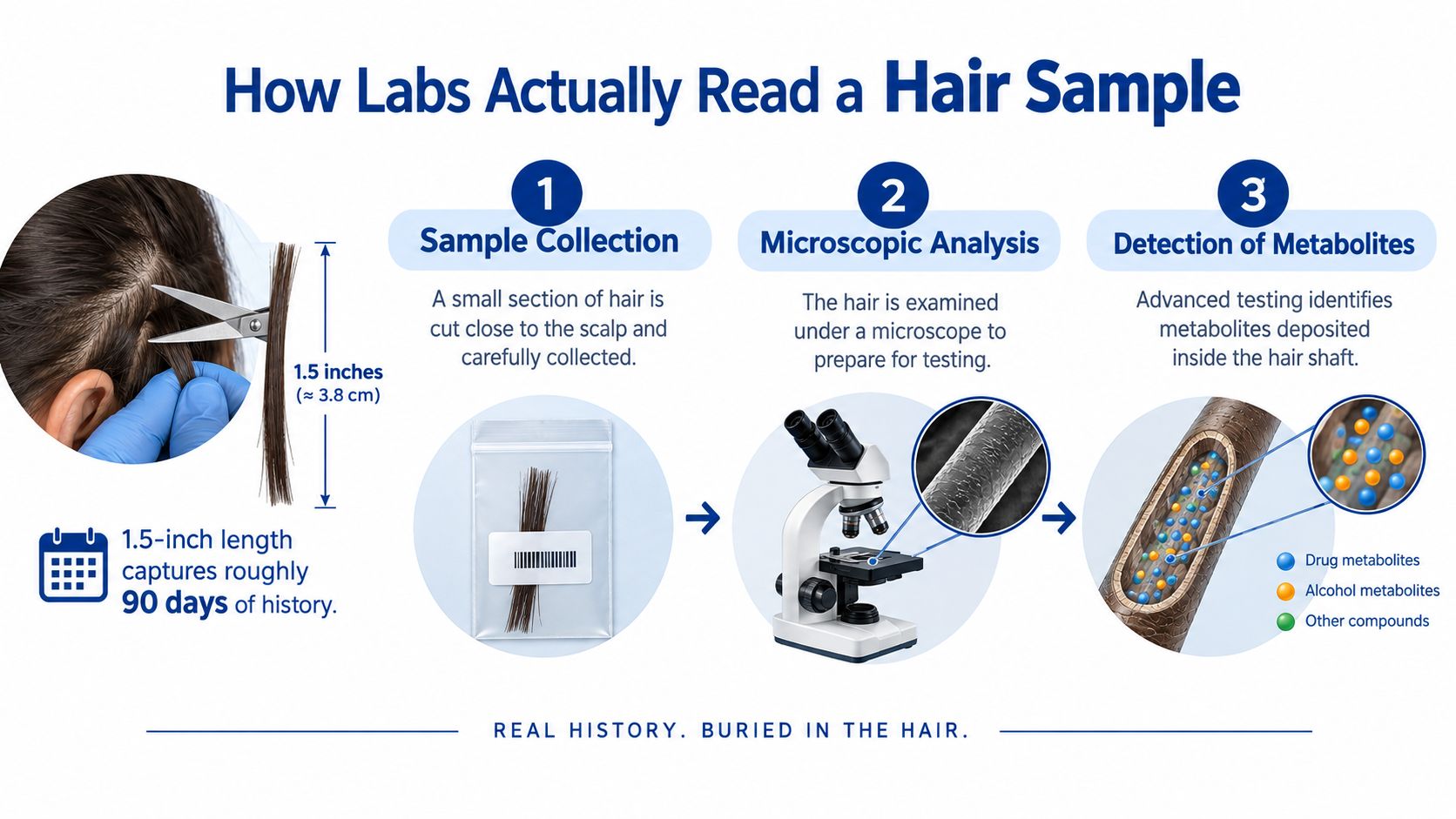
Labs do not read hair as a dirty surface. They cut a scalp sample close to the scalp, then examine the proximal 3 cm as about 3 months of history at the usual scalp growth rate of around 1 cm per month (Society of Hair Testing guidance). That is why a cosmetic wash has limited reach against a lab method built to read what is inside the fiber.
The sample is washed before extraction, and that step matters. The lab is already separating external contamination from incorporated drug, so home washing has to do more than clear visible residue. Published guidance also uses low ng/mg cutoffs, including 0.05 ng/mg for THC, 0.0002 ng/mg for THC-COOH, 0.2 ng/mg for amphetamines and opiates, and 0.5 ng/mg for cocaine.
Why the wash step changes the way you should think
The lab's decontamination step sets the ceiling. Independent literature found that wash durations beyond 30 to 60 minutes did not remove additional drug amounts in one systematic investigation, and a sequential decontamination protocol still left most clinical interpretations unchanged against Society of Hair Testing cutoffs (PubMed record). That is the hard limit people need to understand before they buy a shampoo for hair drug test.
A shampoo can help with surface residue. It cannot rewrite the sample the lab is built to read.
The Two Shampoos People Compare and What Each One Does
People keep asking whether they should buy Macujo Aloe Rid® Shampoo or Zydot Ultra Clean, as if they're competing products. They aren't. They play different roles in the same prep logic, and treating them as substitutes is how people waste money and time.
Macujo Aloe Rid® Shampoo is the required wash inside Mike's Macujo Method. It's used repeatedly across the prep window, alongside the other steps in that protocol. It is not a casual clarifying shampoo, and it's not meant to be judged as a stand-alone miracle bottle.
Zydot Ultra Clean is a finishing shampoo. In the way it's used in this topic, it belongs near the end, on test day, to help clear surface residue and buildup. That means it's the last pass, not the whole plan. If you try to replace the Macujo wash sequence with Zydot alone, you've skipped the part that gives the routine its structure.
| Feature | Macujo Aloe Rid® Shampoo | Zydot Ultra Clean |
|---|---|---|
| Purpose | Core wash in Mike's Macujo Method | Final cleansing step before collection |
| Use pattern | Repeated during the prep cycle | Single finishing use |
| Role in routine | Foundational, not optional inside the method | Supportive, not a substitute |
| Best fit | Heavier or repeated exposure | Final-day cleanup |
The main mistake I see is customers shopping as if the two bottles are interchangeable. They're not. One is the engine, the other is the polish. If your hair history is light, the older Macujo lineage may be the simpler fit. If your exposure is heavier, the modern Mike's version is the one people usually mean when they talk about a serious prep routine.
Mike's Macujo Method Versus the Older Macujo Method
The older Macujo Method came first, around 1999–2000, and it was built around vinegar, detergent, and a single wash cycle approach for lower to moderate exposure. The newer Mike's Macujo Method keeps the same cleansing lineage but adds Macujo Aloe Rid® Shampoo, Clean and Clear Pink, baking soda, and repeated cycles for heavier use patterns. Supreme Klean's guide on the method lays out that updated structure in product terms: the Macujo Method guide.
What changed matters. The older version was simpler and narrower in scope. Mike's version formalized a more aggressive routine because people weren't asking only about one-time THC exposure anymore, they were asking about repeated use, tighter timelines, and more complicated test situations.
How the two versions differ in practice
| Component | Original Macujo (1999–2000) | Mike's Macujo Method |
|---|---|---|
| Core wash | Old Style Aloe Rid lineage | Macujo Aloe Rid® Shampoo |
| Support products | Vinegar, liquid detergent | Vinegar, Clean and Clear Pink, baking soda, detergent |
| Repetition | Single-cycle emphasis | Repeated cycles |
| Exposure target | Lower to moderate use | Heavier or repeated exposure |
| Prep timing | Less formalized | Built around a longer pre-cleanse window |
The key point is simple. The newer method exists because the older one wasn't enough for every case. When people say “Macujo,” they often mean Mike's updated version, not the original protocol. I'm using it that way here.
What Forensic Research Says Shampoo Can and Cannot Remove
Forensic decontamination studies set the limit here. Hair washing can reduce surface contamination, and that matters because outside residue is real. It does not reliably remove drug markers already built into the hair shaft.
A separate forensic investigation found that even wash methods following Society of Hair Testing recommendations could not completely remove external cocaine and methamphetamine contamination. The authors concluded that preparative solvent washing helps maximize recovery and detectability of metabolites rather than acting as a guaranteed removal step (SAMHSA literature summary). Washing changes measured concentrations, but it does not erase the test.
What the science means for your shampoo choice
Independent laboratory work shows why one shampoo pass is a weak bet. In one study, wash durations beyond 30 to 60 minutes did not remove additional drug amounts, and a sequential decontamination protocol still left most clinical samples interpreted the same way against Society of Hair Testing cutoffs (PubMed record).
That is the ceiling. Aggressive washing may change the quantity the lab measures, but it does not guarantee a different yes-or-no outcome. So when people ask whether Macujo Aloe Rid® “works,” the honest answer is straightforward. It has a role in a layered cleaning routine. It is not a standalone override for incorporated drug history.
Bottom line: shampoo can reduce what sits on the outside. It cannot reliably strip the inside of the strand.
How Mike's Macujo Method Uses Macujo Aloe Rid® Shampoo
The method only works if you follow the sequence. Start with wet hair and warm towel prep, then use Macujo Aloe Rid® Shampoo as the foundation wash. After that, the protocol adds Clean and Clear Pink, baking soda in warm distilled water, and vinegar in the stated order.
People buy the official bundle because the bottle count matches the wash cycles. The number of passes depends on exposure history. Light or one-time use a week out calls for a different workload than heavy daily use, so the routine scales with the situation. That is exactly why a random clarifying shampoo or salicylic-acid shampoo is the wrong substitute. The formula and detergent balance in Macujo Aloe Rid® Shampoo are part of the method, not a side detail.
That's exactly why the official Macujo Aloe Rid® Shampoo and Zydot Ultra Clean bundle comes with the bottle count matched to the wash cycles. The bundle supports the full sequence, instead of asking one bottle to do every job.
What not to do
- Don't swap in a generic clarifier: It changes the routine and creates false confidence.
- Don't compress the sequence: The order matters more than people want to admit.
- Don't assume one cycle is enough: Exposure history decides the number of passes, not wishful thinking.
Zydot Ultra Clean enters at the end, and that is the right place for it. Use it as the final rinse on test day, not as a substitute for the wash-time sequence. If you are building a routine, treat the Macujo shampoo as the core and Zydot as the last support step.
Body Hair, Last Minute Fixes, and Common Misreads
Body hair changes the job. Scalp hair is usually discussed in the standard 1.5-inch or roughly 3-month frame, but body hair can reflect a much longer history, potentially up to 12 months, and labs often turn to it when scalp hair is not available (body-hair testing guidance). If the sample comes from the chest, arms, or legs, a scalp-hair routine is already off target.
That is why same-day fixes are overhyped. A wash on the morning of the test mainly clears surface residue. It does not remove incorporated drug markers already inside the hair shaft, and an expensive bottle does not shorten the lookback window.
The two mistakes people make most often
- Mistake one, treating body hair like scalp hair: The timing window is different, and the sample is not read the same way.
- Mistake two, believing heavy daily washing is enough: Routine washing cleans the surface, but it does not replace the Macujo sequence.
- Mistake three, waiting until the last minute: Planning should start before collection day. If body hair is in play, start earlier and read how to approach a hair drug test without shaving.
The other problem is verification. Labs generally do not have a routine way to objectively screen for cosmetic treatment or extensive hair washing, and available methods cannot directly prove shampoo history (PMC review). That is why buyers fixate on what shampoo “does,” while the lab mostly sees markers and results.
If the test may use body hair, do not improvise on collection day. Body-hair prep needs earlier planning, and waiting until the end is the wrong move.
Matching the Right Routine to Your Situation
The cleanest way to choose is by exposure level, not by brand hype. If you're a light or one-time user facing a pre-employment screen, the older Macujo Method is the lighter alternative people usually start with. If you're dealing with moderate weekly use or a short-notice test, you want the updated Mike's Macujo Method with repeated wash cycles and the proper shampoo sequence.
For heavy daily users or people with legal or employment consequences, the prep window matters more than any bottle label. The routine has to start earlier, the wash count usually increases, and Zydot Ultra Clean stays what it is, a final-rinse finishing step, not a stand-alone answer.
| Exposure Level | Prep Window | Wash Cycles | Zydot Role |
|---|---|---|---|
| Light or one-time use | Short, but not same-day | Fewer cycles | Final rinse only |
| Moderate weekly use | Several days | Repeated cycles | Final rinse only |
| Heavy daily use | Start as early as possible | More cycles | Final rinse only |
I'm blunt about this because customers deserve blunt advice. No product, method, or vendor can guarantee a specific lab outcome, and the only risk-free result is abstinence. If you still need a hair-test prep kit, choose the routine that matches your exposure level, follow it exactly, and don't waste time pretending every shampoo does the same job.
If you need a straightforward source for authentic Macujo Aloe Rid® Shampoo and the matching Zydot Ultra Clean bundle, Supreme Klean carries the hair-test products people ask for when the clock is already ticking. Visit Supreme Klean to compare the current options and read the product instructions before you buy.
Created with Outrank tool
